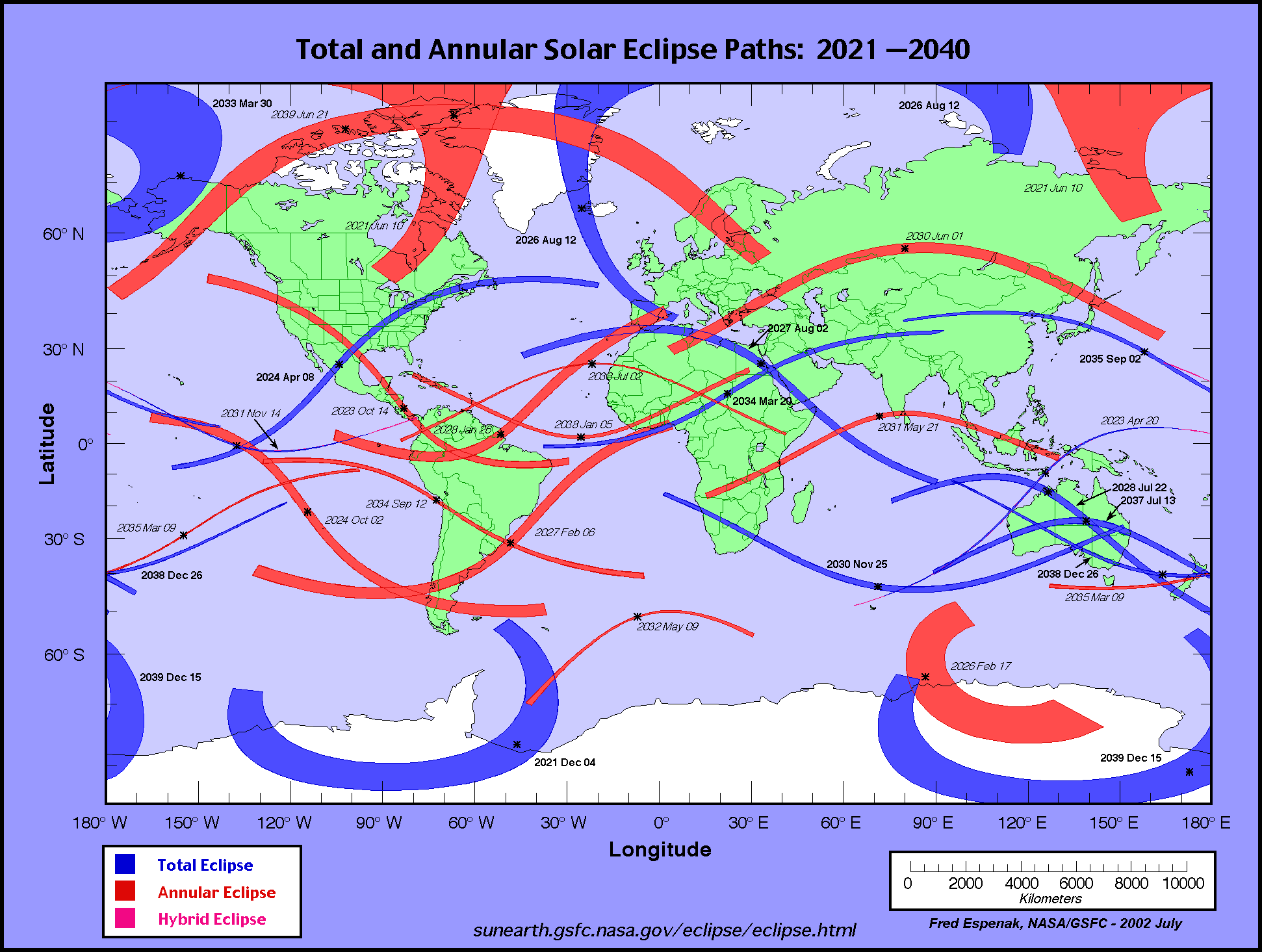
The following table contains the Besselian elements for the Annular Solar Eclipse of 2026 Feb 17 .
The geographic coordinates of the eclipse path are listed in the Path Table . The global visibility of the eclipse is shown on an Orthographic Map . The path of the eclipse is displayed in greater detail on an Google Map .
            Besselian Elements for the Annular Solar Eclipse of  2026 Feb 17
            Equatorial Conjunction:     11:19:58.4 TDT     J.D. = 2461088.972204
              (Sun & Moon in R.A.)    (=11:18:47.2 UT)

             Ecliptic Conjunction:      12:02:17.2 TDT     J.D. = 2461089.001588
             (Sun & Moon in Ec. Lo.)  (=12:01:06.0 UT)

                  Instant of            12:13:05.4 TDT     J.D. = 2461089.009090
               Greatest Eclipse:      (=12:11:54.1 UT)


            ---------------------------------------------------------------------------
                        Gamma = -0.9743            Ephemerides = VSOP87/ELP2000-85
            Eclipse Magnitude =  0.9630           Lunation No. =     323
                           ΔT =    71.2 s         Saros Series =  121 (61/71)

            Lunar Radius   k1 = 0.272488 (Penumbra)        Shift in      Δb =  0.00"
             Constants:    k2 = 0.272281 (Umbra)       Lunar Position:   Δl =  0.00"

            ---------------------------------------------------------------------------
            Geocentric Coordinates of Sun & Moon at Greatest Eclipse (VSOP87/ELP2000-85):

            Sun:       R.A. = 22h03m54.3s         Moon:      R.A. = 22h05m34.0s
                       Dec. =-11°52'42.2"                    Dec. =-12°42'29.6"
              Semi-Diameter =    16'11.1"           Semi-Diameter =    15'32.4"
                Eq.Hor.Par. =       08.9"             Eq.Hor.Par. =  0°57'02.0"

            ---------------------------------------------------------------------------
            Polynomial Besselian Elements for:   2026 Feb 17   12:00:00.0 TDT  (=t0)

              n        x          y         d          l1         l2          μ

              0   0.322033  -0.926964  -11.87930   0.557719   0.011523  356.51443
              1   0.4827116  0.2355386   0.014049 -0.0001181 -0.0001175  15.001985
              2  -0.0000336  0.0001168   0.000002 -0.0000111 -0.0000111
              3  -0.0000049 -0.0000033

                             Tan ƒ1 = 0.0047320    Tan ƒ2 = 0.0047085

            At time t1 (decimal hours), each Besselian element is evaluated by:

               a = a0 + a1*t + a2*t^2 + a3*t^3    (or a = Σ [an*t^n]; n = 0 to 3)

                  where:    a = x, y, d, l1, l2, or μ
                            t = t1 - t0  (decimal hours) and t0 = 12.000 TDT


            The Besselian elements were derived from a least-squares fit to elements
            calculated at five uniformly spaced times over a six hour period centered at t0.
            The Besselian elements are valid over the period  9.00 ≤ t0 ≤ 15.00 TDT.

            Note that all times are expressed in Terrestrial Dynamical Time (TDT).

                   Saros Series 121:  Member 61 of 71 eclipses in series.
   Instant of
Greatest Eclipse:       Time =  12:11:54.1 UT       Lat = 64°43.0'S      Long = 086°45.2'E
      (GE)               Sun Altitude =  12.3°          Path Width = 616.6 km
                          Sun Azimuth = 268.2°    Central Duration =   02m19.6s


   Instant of
Greatest Duration:      Time =    11:48:16 UT       Lat =   71°57'S      Long =   136°39'E
      (GD)               Sun Altitude =   0.0°          Path Width = 766.1 km
                          Sun Azimuth = 228.4°    Central Duration =   02m20.9s
Predictions for the Annular Solar Eclipse of 2026 Feb 17 were generated using the VSOP87/ELP2000-85 solar and lunar ephemerides and a value of ΔT = 71.2 seconds. The luanr coordinates have been calculated with respect to the Moon's Center of Mass. They DO NOT include a correction to the Center of Figure, or the effects of mountains and valleys along the edge of the Moon.
All eclipse calculations are by Fred Espenak, and he assumes full responsibility for their accuracy. Permission is freely granted to reproduce this data when accompanied by an acknowledgment:
"Eclipse Predictions by Fred Espenak, NASA's GSFC"
For more information, see: NASA Copyright Information